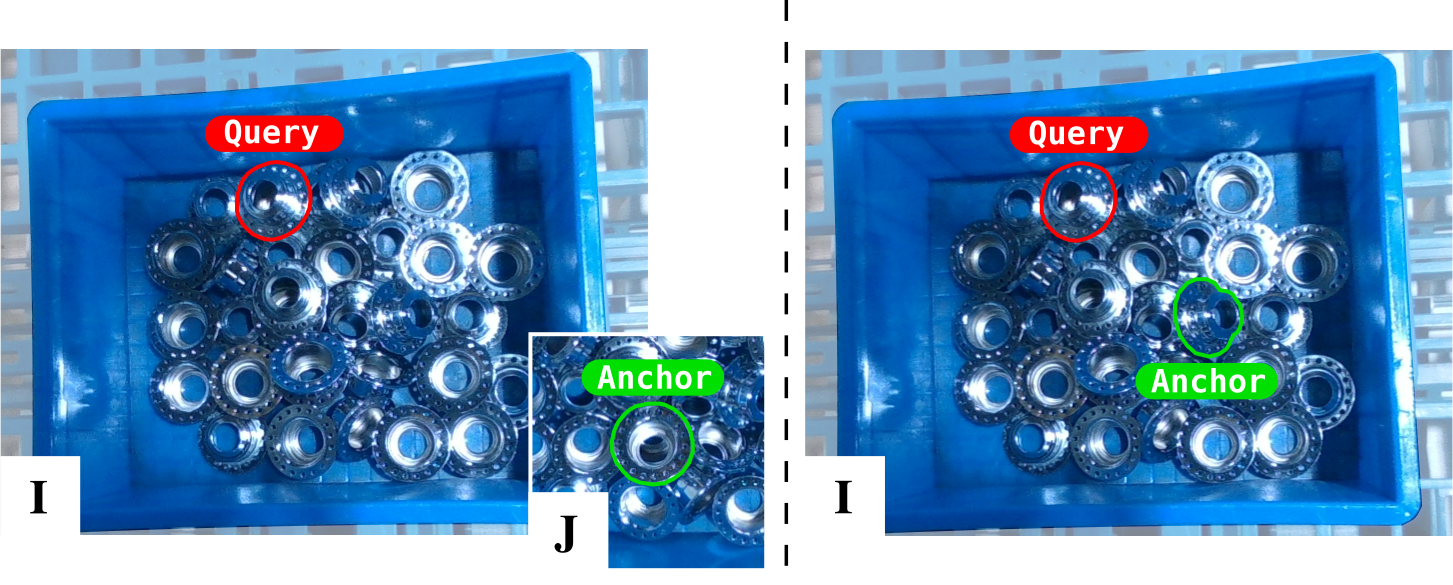
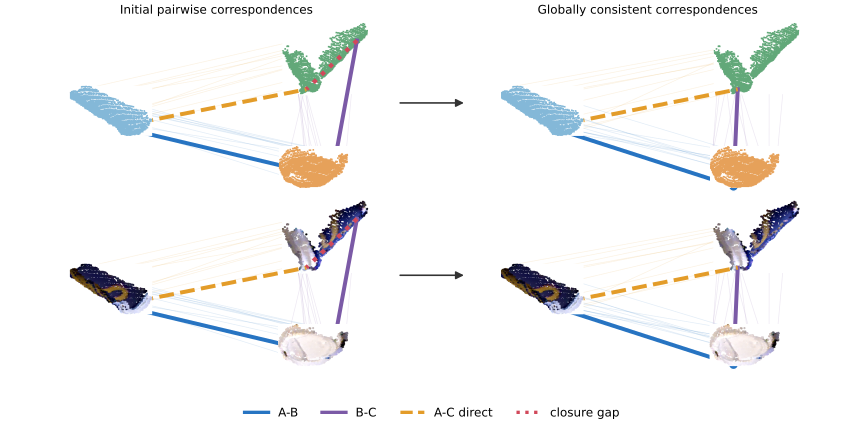
Object 6D pose estimation formulations have progressively reduced reliance on object-specific priors, evolving from explicit 3D models to multi-view object captures to single reference images. We take this progression to its extreme by introducing prior-free relative 6D pose estimation, which lifts the assumption of knowing which object is to be posed within the scene. This novel setting aims to estimate the relative poses of multiple instances of an unknown object within the same image, without requiring CAD models, templates, or reference images. We solve this by formulating a novel method (PROSE) that finds coarse correspondences between object instances using multimodal foundation features, thus requiring no training. We refine these correspondences by imposing cycle consistency across tuples of instances, and leverage the resulting globally consistent correspondences to estimate the relative 6D pose between any pair of instances. To enable systematic evaluation, we design a novel benchmark (PRENCH) built from three multi-instance BOP datasets and enriched with task-specific metadata. PROSE consistently outperforms baselines obtained by adapting state-of-the-art single-image methods to the proposed setting, while requiring neither task-specific supervision nor additional learned components.
| Method | IC-BIN | IC-MI | XYZ-IBD | |||||||||
|---|---|---|---|---|---|---|---|---|---|---|---|---|
| AR ↑ | ADD(S) ↑ | RE (°) ↓ | TE (mm) ↓ | AR ↑ | ADD(S) ↑ | RE (°) ↓ | TE (mm) ↓ | AR ↑ | ADD(S) ↑ | RE (°) ↓ | TE (mm) ↓ | |
| One2Any | 17.7 | 61.0 | 70.5 | 26.9 | 47.7 | 98.0 | 47.2 | 12.3 | 9.2 | 49.2 | 85.0 | 33.2 |
| ConceptPose | 18.8 | 58.8 | 76.2 | 36.6 | 50.8 | 80.2 | 51.1 | 29.1 | 36.1 | 70.1 | 64.6 | 24.4 |
| PROSE (ours) | 38.0 | 83.3 | 61.3 | 16.8 | 70.3 | 100 | 30.4 | 4.6 | 55.8 | 92.1 | 28.6 | 9.1 |
| Improvement | +19.2 | +22.3 | −9.2 | −10.1 | +19.5 | +2.0 | −16.8 | −7.7 | +19.7 | +22.0 | −36.0 | −15.3 |
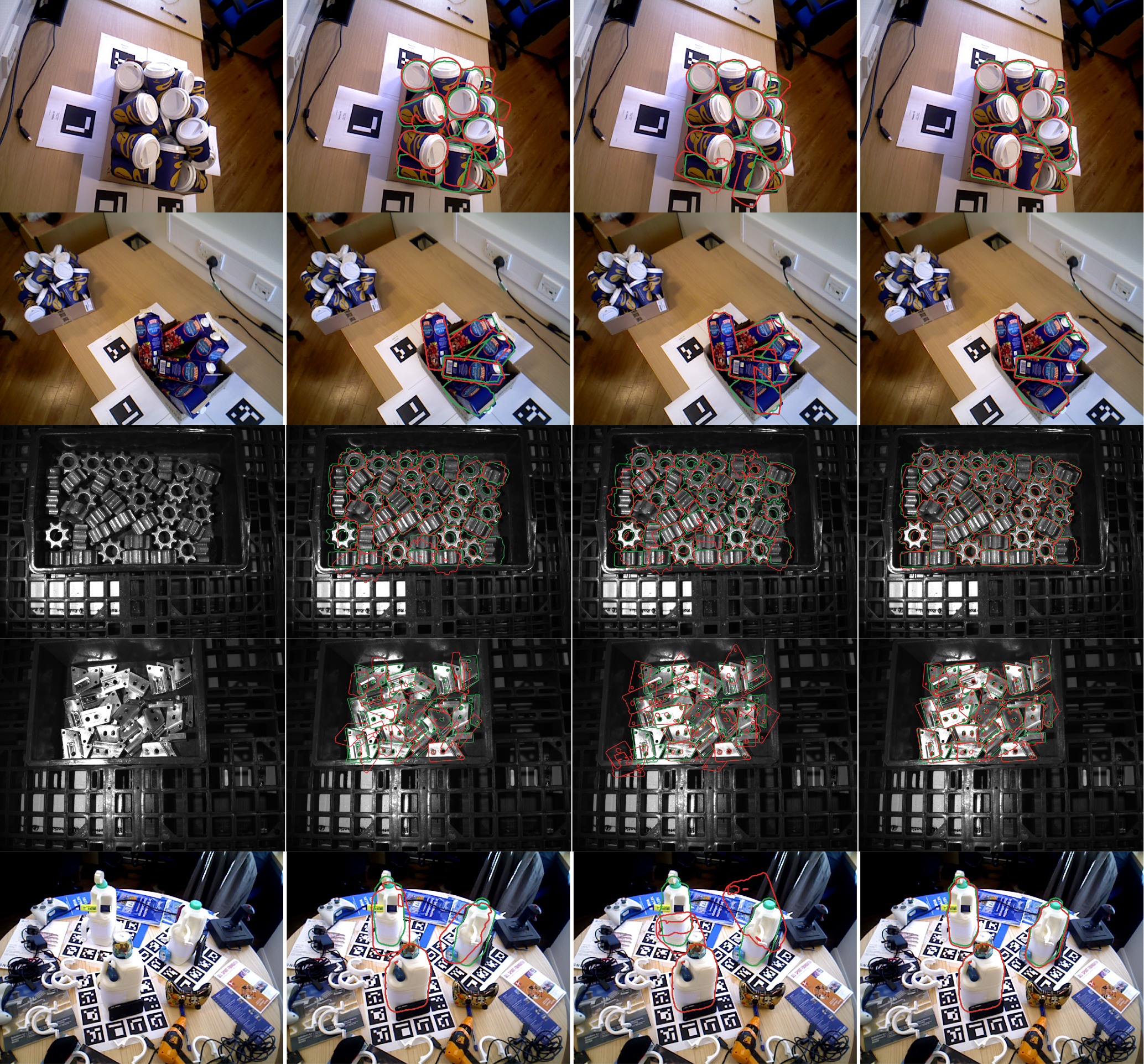
Across all three PRENCH datasets, PROSE achieves the strongest performance on every reported metric, improving average recall by about 19 points over the strongest competing method while also reducing rotation and translation errors. This consistent improvement is important because the datasets cover different challenges, from densely packed everyday objects affected by self-occlusion to industrial components with limited visual texture. The qualitative results support the numerical findings: PROSE's predicted poses align more closely with the ground truth, while One2Any and ConceptPose often struggle when objects overlap or appearance provides too little information. These gains come from combining complementary semantic and geometric features and then refining the initial matches jointly across all visible object instances. By enforcing cycle consistency, PROSE can correct conflicting pairwise matches and use the instances in the scene as mutual references. The method is training-free and requires no CAD model, template, external reference image, or additional task-specific learned component, reducing the setup needed for new objects. Its scope is relative pose estimation from RGB-D observations containing multiple visible instances, so it does not replace absolute-pose approaches when only one instance or no depth information is available.
If you find this work useful, please cite:
@misc{khodabandehloo2026prior,
  title         = {Prior-free Relative 6D Pose Estimation of Multiple Object Instances},
  author        = {Khodabandehloo, Behdad and Caraffa, Andrea and
                   Boscaini, Davide and Poiesi, Fabio},
  year          = {2026},
  eprint        = {2609.08949},
  archivePrefix = {arXiv},
  primaryClass  = {cs.CV},
  url           = {https://arxiv.org/abs/2609.08949}
}